
Learning and Practice: Thinking Beyond Behaviour
Updated: Jun 3

By Fiona Stocker
Head of Programmes - Borough Provision
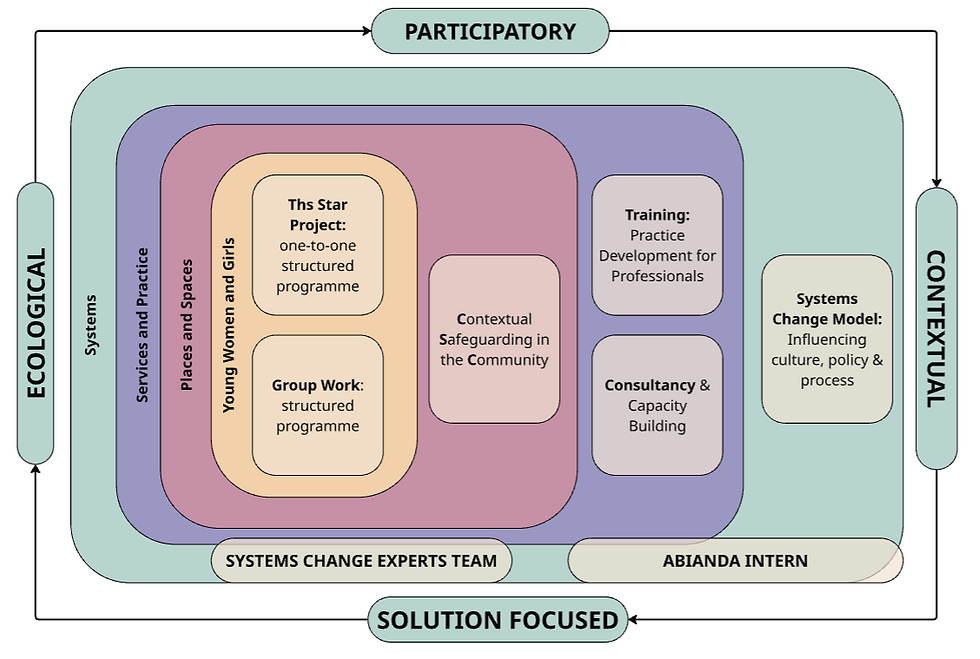
Our ecological model is something we use to understand how harm shows up for young women and girls affected by criminal exploitation and violence, to articulate the service response needed for their care to be effective, and to evidence the ways that they can too often be made invisible within the systems that they should be able to rely on to create safety.
If you aren’t working ecologically (and it can be very difficult to do so), it’s possible that you may be drawn towards a behaviour change response. On the surface, you may think: why wouldn’t we work towards behaviour change? If the young woman takes fewer risks, won't that reduce harm and increase safety? Let’s touch on the difference between the two approaches…
A behaviour change response looks to change the behaviour of an individual. When this is the approach we rely on, responsibility for change can become placed too heavily on young women and girls’ shoulders. A requirement for behavioural change can miss the extra-familial and contextual nature of harm that she may have limited or no power to control. This can result in young women and girls feeling blamed for harm they have experienced as a result of their exploitation.
We endeavour to work ecologically in our 1:1 work - on our flagship service, the Star Project. We meet countless young women and girls doing their best to navigate systems, services and spaces that were not always designed with their specific safety, needs and experiences in mind. As well as building her independence and agency in navigating these systems as they are (while actively challenging the culture of blame), at Abianda we see it as integral to our work, in order to be most effective for young women and girls, to interact with and influence the systems themselves. We think ecologically.
One way we do this is through our training programmes, rolled out to professionals across all relevant sectors, such as education, social care, policing, health, youth justice, youth work and beyond.
Our ecological model starts with the young woman or girl at the centre. Take one step out and you reach the places and spaces that she moves through daily. Take another and you’re thinking about services. Take a final step and you’ll be considering wider systems and power structures. Our 1:1 work supports young women to engage with how these contexts impact their daily lives: where they may mitigate harm and increase safety, and where, in some cases, they may unintentionally perpetuate or further compound harm.
What we learn as a result of walking alongside young women in these conversations, directly influences the training we deliver. Young women and girls’ voices are held central and woven throughout.
What do they want to see services doing differently?
What great practice have they experienced and want to see more of?
What do systems really need to understand to respond effectively to young women and girls’ experiences of criminal exploitation and violence?
One example of a service already thinking ecologically and eager to understand more through working with Abianda, is West Sussex Youth Justice Service, who we are excited to be working with through 2026/27. West Sussex YJS have brought together delivery partners from across the borough to create a cohesive and clear approach. We’re so excited to see what we can create together for young women and girls, and look forward to being able to report back on the impact that working ecologically can have.


